For anglers
How to release a carp safely: catch-and-release guide
4 min read
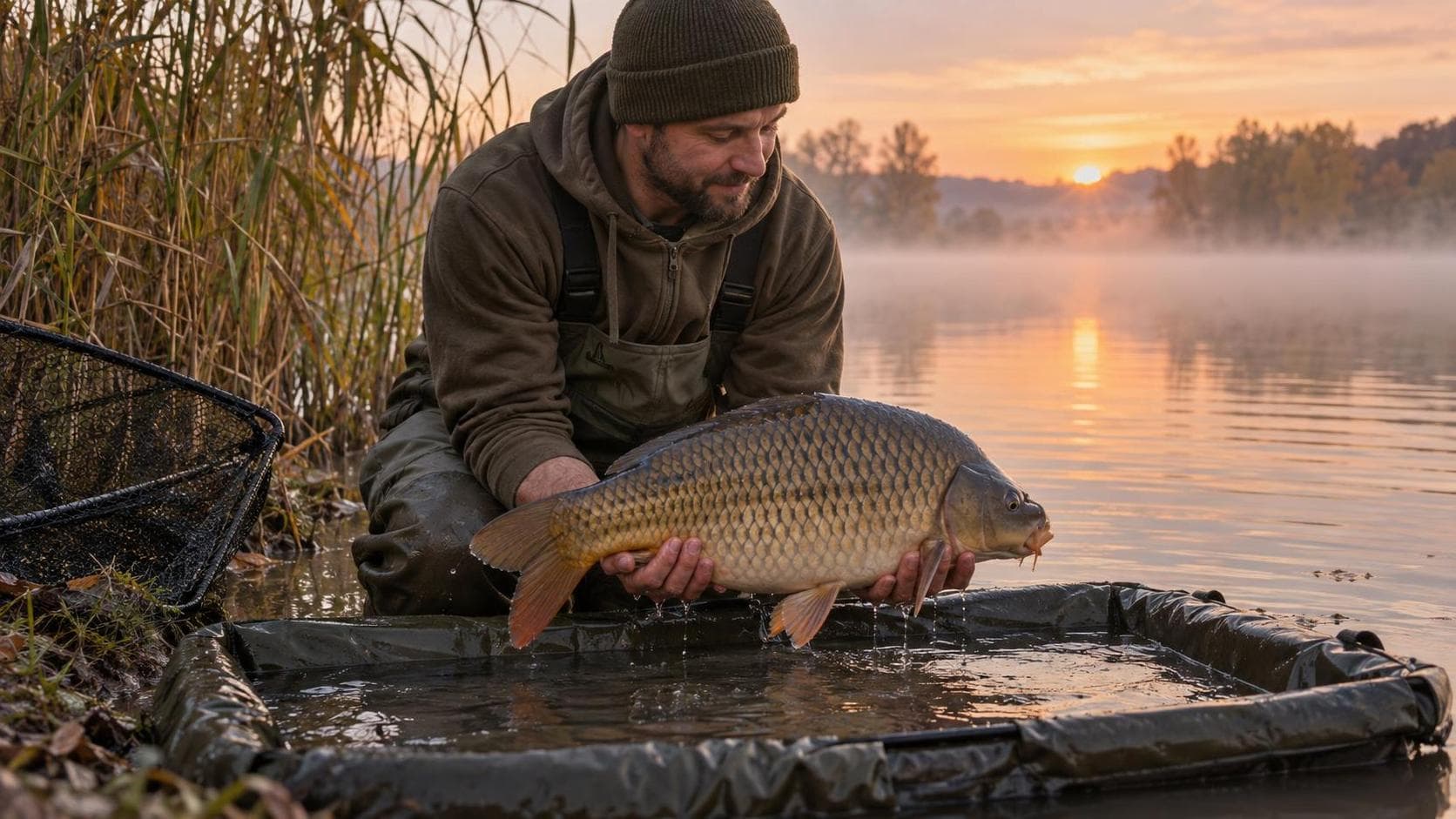
Releasing a carp does not mean simply removing it from the hook and throwing it into the water. The greatest risk for fish occurs on the shore: a dry surface damages the protective mucus, a high lift ends in a fall, and a long photo session adds stress.
The safe principle of "catch and release" starts before casting. Prepare the area in such a way that after hooking up there is no need to search for the mat, water or tool all over the sector.
What to prepare for the bite
Place the carp mat or cradle on a flat area away from stones, branches and the edge of the platform. Keep a large bag, a container of pond water, and tongs or an extractor nearby. If regulations require a fish antiseptic, use only the product specified for that purpose as directed.
Check the mat and net for any sharp fasteners, dry dirt, or tangled hardware. Wet the mat, the net and your hands with water from the pond.
How to transfer the carp to the mat
Do not lift a large carp only by the handle of the bag. Assemble the net so that the fish stays on the bottom, check the fins and support the weight on the bottom. Carry the fish low above the ground.
On the mat, hold the carp horizontally: one hand under the pectoral fins, the other at the base of the tail. Do not pick up the fish by the gills, eyes or mouth and do not stand upright on the tail.
Removing the hook without unnecessary injury
Slacken the line and remove the hook in the direction opposite to the entrance. Do not pull the snap. If the hook is deep, tangled near the gills, or you can't see a safe way, call a reservoir official or an experienced angler. Sometimes it is safer to detach the rig than to tear the tissues.
Inspect the mouth, fins and sides. Do not apply household antiseptics, alcohol or random ointments. In case of serious injury, notify the administration.
Photo: low, fast and above the mat
Set up the camera in advance. Lift the carp only by squatting or on your knees, hold it over a wet mat. Capture seconds, not minutes. If the shot is not successful, first let the fish recover in the water.
In the heat, severe frost or after a long period of balancing, it is better to shorten or skip the photo. The welfare of the fish is more important than the frame.
How to return the carp to the water
In the water, support the carp horizontally, with its head in clean water without thick mud. Do not pull sharply back and forth: hold calmly until the fish begins to confidently work its tail.
Release when the carp keeps its balance and tries to swim. If it falls to the side or does not recover, contact the reservoir staff.
Short checklist
- mat, bag, water and tools are ready;
- hands, mat and net are wet;
- fish low above the soft surface;
- gills and eyes are not touched by hands;
- photo is prepared in advance;
- carp returns to the water under control;
- local rules take precedence.
Check the rules of the water body before leaving
One body of water provides a mat and pad, the other requires your own kit. Requirements for equipment, antiseptics, storage of fish and photos also differ. Check this before booking.
In Pegly you can view the reservoir page, sectors on the map, available sessions, prices and published rules, then submit a request for a specific location. If the condition is not described, ask the owner before arrival.